Category Archives: Bavaria

Tour the castles of “Mad King” Ludwig II – “The Fairytale King”

Southern Bavaria has some great attractions, but few can compare to the castles of King Ludwig II. If you are spending time in Munich or Salzburg, it’s worth a day trip or two to check out the castles. If you are in Munich, you can start your adventure by checking out the Moon King’s boyhood home.

Munich

Thrown into power at age 18, Ludwig II longed to be as awesome as Louis XIV, but sadly, his country had neither the budget nor the patience to let the boy king plow ahead with fabulous construction projects that threatened to bankrupt the monarchy.

King Ludwig II (1845-1886)

Fascinated by art, history, literature, opera and composer Richard Wagner, he didn’t travel much, but longed to emulate places he had read about. He wrote in his diary: “I want to remain an eternal mystery to myself and others.”

Ludiwg Otto Friedrich Wilhelm – Ludwig II of Bavaria – ascended the throne at the age of 18.

Declared incompetent at age 40, he was found mysteriously drowned just days later, along with the psychiatrist that declared him incompetent. His younger brother Otto, whom he had bequeathed the monarchy to upon his death, was immediately declared mentally ill and Ludwig II’s uncle ascended to the throne.

Neuschwanstein

If you are up for touring castles with features that are stunning, remarkably high-tech, and always awe-inspiring, GetAway Travel is ready to set up your itinerary so you can soak up the ambiance of the ill-fated boy king and his many residences.

A fairytale without an ending

 Ludwig left his mark on a number of castles and properties. He built three castles, but spent quite a bit of time living in manors and alpine retreats. His most famous castle was built last, but not finished before he died. Neuschwanstein, or New Swan Stone Castle, near the border of Austria, was constructed in the Romanesque Revival style. It looks like a castle that just appeared in a fairytale and it so charmed Walt Disney, he used it as a model for Sleeping Beauty’s castle

Ludwig and Otto spent a large part of their childhood at Hohenschwangau Castle and from there Ludwig could see castle ruins on the opposite hill. There, he vowed, he would build his dream castle in the style of the authentic German knights’ castles. The castle was to be his personal retreat and honor composer Richard Wagner.

Hohenschwangau Castle

Ludwig concerned himself with every detail of Newuschwanstein, from the murals to the dishes. Construction proved to be quite a bit of an endeavor. Because he wanted it perched on the hillside, it took a serious quantity of explosives to blow through 27 feet of solid rock to set the castle foundation. His use of steel T-beams and plastered cast-iron pipes was modern for that time.

Singers Hall in Neuschwanstein Castle

The castle is decorated in Wagner opera themes. The dining room murals are scenes from the Wartburg Singers Festival. The bedroom has scenes depicting the doomed love affair between Tristan and Isolde on the carvings on the oak walls. The story of Tannhauser is showcased on the walls of the study and Lohengrin, Ludwig’s hero, and Lohengrin’s swans, are everywhere! They are painted on the walls, carved into the ceiling and door arches, cast in porcelain and woven into tapestries.

He had a fake grotto with fake stalactites constructed where he could enjoy performances of Wagner’s operas. Here, as he did in other residences, gardens were constructed so he could look out the windows and enjoy them, and they would block the outside world.

Richard Wagner (1813-1883) one of the world’s most influential & controversial composers

The throne room is the centerpiece of the castle. In the Byzantine style, it’s decor was inspired by St. Sophia Cathedral in Istanbul. More than two million small tiles are used on the floor to illustrate forest animals and the columns, with gilded tops, are painted to appear that they are made of bright lapis lazuli.

Neuschwanstein Throne Room

It was not finished before he died and sadly, he spent only 11 nights sleeping there.

Herrenchiemsee Palace, Ludwig’s Versaille

 Ludwig juggled multiple projects, much to the consternation of those watching the monarchy’s funds, and he began building Herrenchiemsee Palace in 1878. A great admirer of France’s Sun King, Louis XIV, Ludwig wanted a castle that matched the opulence and panache of Versailles. He also wished to rule like Louis XIV, without constitutional restraints.

Herrenchiemsee island

The island of Herrenchiemsee was purchased from timber barons who hadn’t managed to harvest trees there as they had planned. Constructing a castle on an island in the middle of Lake Chiemsee had its challenges. The lake was very wide and deep and tugboats were used to haul construction materials to the island. Steam-driven pumps were installed to power the extensive array of water features around the palace.

Herrenchiemsee palace

Ludwig’s “must haves” for the palace included the Hall of Mirrors, modeled after the Versailles hall, and the Latona Fountain.

Latona fountain

The wishing table, from the Grimm’s Fairy Tale of the same name, was installed in the dining room. It was a table that would be set with dishes and a meal and rise up through the floor so Ludwig didn’t have to be bothered with interacting with servants. Rumor has it that the table was set for imaginary guests that Ludwig would converse with during the meal.

Herrenchiemsee Palace

The monumental marble staircase is under a roof constructed of iron and glass. This was new for that time and, a special system was designed to heat water and interior rooms by Ludwig. A special system could lower the spectacular chandeliers so they could be cleaned and serviced.

Twelve rooms of the palace are set up as a museum detailing the story of Ludwig II in portraits, busts, historical photos, furniture and clothing. The exhibits also explore Ludwig’s patronage of Wagner in portraits, documents and model theaters and set design.

Main fountain pool at Linderhof

Linderhof, his only completed castle

 The smallest of the three castles, this was the only palace he completed. Built in the 18th century Rococo style, it was originally a humble hunting lodge used by his father. Ludwig moved it on the property to allow for a bigger footprint and then transformed it into a close replica of Marie Antoinette’s chateau that was on the grounds of Versailles.

Linderhof Palace

Technological marvels included a wishing table, that elevated from the kitchen to the dining room and electric lights in the Venus Grotto he had constructed. There was a water heater, wave machine and rumor has it, attendants were ordered to wrangle wild swans into the grotto so Ludwig could float on a mussel-shaped boat in the water and enjoy his favorite fowl.

Linderhof

Bavaria’s first electricity was used here to power the lights in the grotto, the wave machine and the fountain.

Linderhof interior

Ludwig renovated the King’s House on Schachen into an opulent Turkish style den. He re-designed the Munich residence, the Residenz, the largest city palace in Germany. There are ceiling frescoes, a beautiful fountain and courtyard sculptures and an antique collection. He was born in Nymphenburg Palace in Munich. There are several museums on the grounds including ones that house his carriage collection and his sleigh collection. He would go for night-time sleigh rides and had elaborate sleighs equipped with battery-operated light bulbs. He received guests at, and renovated Rose Island in Lake Starnberg. The new palace there wasn’t completed, but the villa is surrounded by fabulous gardens.

Rose Island on Lake Starnberg

In your travels to Bavaria, do make sure you check out the residences and castles of the ill-fated  mad king — a travel advisor at GetAway Travel can include that in your travel adventure! We can be reached at:  (262) 538-2140, e-mail: sue@getaway.travel or paul@getaway.travel


Munich: Oktoberfest and so much more

Bavaria’s capital has what is recognized as one of the most beautiful town squares. The largest state, by land, in Germany, also has internationally acclaimed museums, historic cathedrals and, of course, Oktoberfest. And, here at GetAway, we can certainly tell you that you don’t have to go to Oktoberfest to enjoy the beer. So while you are wrapping your head around that, and the fact that Oktoberfest is barely in October, we invite you to let GetAway help you getaway to Munich.

Let’s get Oktoberfest, beer and food out of the way…

 Oktoberfest actually runs from mid to late September until the first Sunday in October. It was originally a giant wedding reception when Bavarian Crown Prince Louis decided to invite all of Munich to celebrate his marriage to Theresa von Sachsen-Hildburghausen. The fields where the celebration was held were named Theresienwiese.

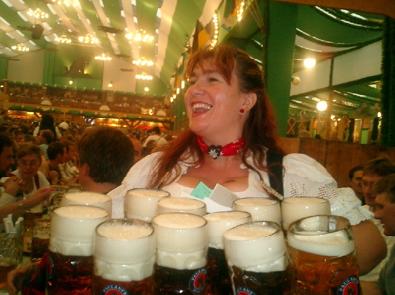
So each year the giant beer fest, with 14 beer tents, as well as food tents, carnival games and rides, occupies 420,000 square feet of the fields. Six local breweries provide the beer and there’s a whole set of rules and reservation requirements to get into some of the beer tents. Read up before you go. Also, remember these two words: alcohol content. The average beer in the US is about 5% alcohol. The average alcohol content in the beer in those giant tankards you’ll be guzzling at Oktoberfest is between 5.9 and 6.2%. Drink responsibly.

Beer, beer, beer, beer and beer

Pork, potatoes, sausage, bread, while that seems to be a weighty list, it’s all in the preparation and moderate servings. Weisswurst is a traditional Bavarian sausage that is usually eaten with between breakfast and lunch with mustard. Typically the sausage is removed from the casing before eating – tradition says to suck it out , but you can be more discreet and cut it lengthwise and roll the meat out of the skin with a fork.. Open and consume.

Griessknockerlsuppe, a long name, but it is chicken soup with lovely semolina dumplings instead of noodles. Bavarian goulash and semmelknoedel is a fabulous smoky-flavored concoction which includes semmelknoedel, a bread dumpling which is almost like a stuffing ball.

Bavarian Goulash with dumpling

Knoedel is a giant potato dumpling or two served with a roasted ham hock (schweinehaxe) or roulade (filled, rolled meat). Käsespätele (think Bavarian macaroni and cheese) is noodles or mini-dumplings with lots and lots of cheese topped with carmelized onions baked until a crispy crust forms on top. In the spring, there’s plenty of dishes with delicate white asparagus.

Bavarian Krapfen

Sweets? Oh, yes. Kuchen is cake and it’s an art form in Munich. Kuchens are piled up in cases at bakeries and you can choose among the awesome selections.

Apple Kuchen

Krapfens are huge jelly-filled powdered doughnuts. Windbeutels are cream puffs for giants, split and filled with plain cream or strawberry or raspberry cream dipped in chocolate.

Windbeutels

To drink, there’s beer. You can try beer with carbonated lemonade or grapefruit called radler. It is an easy to acquire taste. Apfelsehorle is apple juice and carbonated water. You can find this in vending machines around the city as well as carbonated water with other fruit flavors.

Lemon Radler

Palaces, parks and gardens

 Munich is laid out like most European cities with a central town hall and a nearby plaza. Marienplatz is a beautiful town square ringed by some the most architecturally fabulous buildings in the city. Don’t miss the glockenspiel on the front of New Town Hall, a very imposing neo-Gothic building. At 11 a.m. and noon, 32 life-side figures with tunes playing, perform a royal wedding, jousting tournament and ritualistic dance. The show lasts about 15 minutes and concludes with the golden bird up the top emerging and chirping three times. Tunes are played on the clock’s 43 bells.

Glockenspiel on the “New” Town Hall

The Munich Residenz is a palace/museum. Divided into multiple areas, one consists of 150 “living” rooms — bedrooms, banquet halls, common rooms, living areas, they are well preserved and show the living style of the former occupants. The Treasury is a collection of precious items, one of the best collections in the world. There are crowns, collections of jewels amassed by rulers of Bavaria, goldsmith items, enamels, crystals and ivories.

Munich Residenz

Nymphenburg Palace was the summer residence of the Bavarian rulers. It is considered Munich’s most beautiful palace. It is surrounded by a gorgeous landscaper park complete with water canals, smaller hidden castles and romantic walkways.

Nymphenburg Palace

The English Garden is one of the largest city parks in the world. On the grounds is Monopteros, a Greek-style temple. The Chinese Tower is also an interesting attraction and it’s next door to the second largest beer garden in the city. There are a total of four beer gardens in the park.

At the southern end of the park is Eisbach Wave, where you can go surfing (yes, surfing) year round.

Surfing in Munich

Augustiner-Keller is Munich’s largest independent brewery with a huge beer garden.

Olympic Park is where the Olympic Games were held in 1972.

Olympic Park Munich

Museums and cathedrals

 There are more than 80 museums in Munich. It’s a city that takes its culture and its preservation seriously. The German Museum is the world’s largest science and technology museum. The 20 exhibits feature science and technology from aviation to chemistry, robotics and health. There are interactive exhibits and experiments.

The German Museum

Three separate art museums, Alte Pinakothek, Neue Pinakothek and Future showcase art from different time periods. The Brandhorst Museum is dedicated to contemporary art.

The BMW Museum showcases the company’s 100-year-old history through cars, motorbikes and engines. Next door is Welt which houses BMW’s exotic models that were never imported to the United States as well as models from its other companies, Rolls Royce and the Mini.

The Church of Our Dear Lady, referred to as Frauenkirche, with its two towers topped with domes dominates the city skyline. Built of bricks, it is considered a landmark symbol of Bavaria.

Frauenkirche with its 2 iconic towers – easy to spot in Munich

Asam Church, also known as St. Johann-Nepomuk-Kirche, is a masterpiece. The unique exterior has intricate detailing and the interior ceiling and walls are covered with frescoes and statues.

Asamkirche

St. Peter’s Church is the city’s oldest place of worship. The interior is done in white and gold and the nearly 200-foot high tower has a viewing platforms that offers amazing views of the city. There are eight bells and eight clocks in the tower.

“Alter Peter” – Old Peter, is the oldest parish church in Munich

Intrigued by the idea of visiting Munich? GetAway Travel can craft and adventure including Munich and beyond! We can be reached at: (262) 538-2140, e-mail: sue@getaway.travel or paul@getaway.travel

Bavaria offers castles, tales of the mad king and an unforgettable production

Bavaria is a region in southern Germany bordered by Austria and the Czech Republic. The Danube River winds through the center and it’s home to a lot of endearing old world customs, but it has a culture that is all its own. From beer halls to architecture, the culture of Germany intertwines with Bavarian culture. 

But Bavaria is like a fairy land. It has high mountains, serene lakes as big as oceans, castle ruins, enchanting castles that are still standing, charming medieval towns, quaint villages, tasty cuisine and beverages and the epic Passion Play that takes an entire town to produce. 


If you want to experience the charm of Bavaria, including the Romantic Road and the Passion Play, GetAway Travel has a group trip scheduled. Give us a call today to reserve a spot or two. 

 Is the Romantic Road — romantic? 

 Why, yes, the Romantic Road IS romantic. Honestly, it is the most popular tourist destination in Germany, but GetAway Travel travel advisors will help you navigate your way to the trip you want with enough of the touristy spots to be interesting, but some other great spots, too. 

Germany came up with the name and the destination in the 1950s when it was felt a little encouragement and positivity about the area was needed. It’s the scenic route from the River Main to the Alps and it really has everything. 

 Three walled cities 

Dinkelsbühl  Nördlingen and Rothenburg ob der Tauber are the three walled cities left in Bavaria and they happen to be on the Romantic Road route. 

Rothenburg ob der Tauber

Dinkelsbühl made it through the Swedish invasion in 1632 and in 1826 King Ludwig I issued a proclamation preserving the city buildings, walls and towers. Since the late 1800s, artists from around Europe have made Dinkelsbühl their home and the city has many artist studios which makes for great shopping opportunities. It’s a lovely city with homes painted in bright pastel colors with window boxes crowded with a profusion of flowers. 

Speaking of shopping, Rothenburg ob Der Tauber, which was the second largest city in Germany in the middle ages, has some spectacular Christmas shops including Käthe Wohlfahrt Christmas Village which also contains a German Christmas Museum. 

Nördlingen is a circular walled city and the original theory was that it was built in a depression left by a volcano. And while that is interesting, the city is actually built in a depression from a meteor strike, which is even more interesting! When the meteor struck, it created something called suevite rock which contains glass and microscopic diamonds.The diamonds are built into the buildings and St. George’s Church contains more than 5,000 carats in diamonds. 

The city has a crater museum where American astronauts underwent geological training before making their trips to the moon. 

 Palaces galore, including the Mad King’s creations 

 King Ludwig II was king for all of two years before he was deposed for his lavish and maniacal spending, imprisoned in one of his own castles and he drowned in a lake of waist high water one day later with the doctor who had ruled him insane. He had three castles in various stages of construction when he was deposed. 

The most famous of Ludwig II’s castles is Neuschwanstein. Perched on a rocky ledge overlooking a grotto, it provided the inspiration for the castle in Cinderella. It, as well as his other castles, were actually not designed by architects, but by an opera set designer. Neuschwanstein was built with creature comforts including running water, an elevator, forced air heat and flushing toilets. The grand rooms were decorated in themes concentrating on heroic legends, operas and romantic literature. 

Linderhoff Place, in Ettal, is the smallest of Ludwig II’s palaces and the only one that was completed. It is modeled after Versailles and the lavish interior has an abundance of elaborate carvings with lots of gold leaf. The Moroccan House is on the palace grounds as well as a man-made Venus grotto. The sculpted gardens are accented by the picturesque backdrop of the foothills of the Alps. 

Linderhof

Hohenschwangau

One of the other castles of note on the Romantic Road is Heidelberg Castle. Set about 300 feet above the city, it is actually several buildings which ring a courtyard. The buildings were each built at a different time so they are in different architectural styles. It offers fabulous views of the countryside and — the world’s largest wine barrel! In 1751 Prince Elector Karl Theodor decided local winemakers needed to pay wine as their tax so he had the barrel built. It holds 58,124 gallons and it has a dance floor on the top. 

Moat at Heidelberg Castle

 The Passion Play and more places of note 

 In 1634 the villagers of Oberammergau prayed they would be spared from a plague and promised if they were, every 10th year they would perform a grand production commemorating the death and resurrection of Christ. Postponed for the past two years, the play will be presented in 2022.  

Presented in German, English text is provided and it runs for five hours. Yes, five hours, but you do get a meal break! Performed on an open air stage, it takes more than 2,000 performers, musicians and stage technicians to complete. 

Garmisch-Partenkirchen are two towns that were joined in 1936. One of the area’s top winter sports destinations, Garmisch is modern and trendy while Partenkirchen to the east exudes Old World charm. 

Ten minutes away is Eibsee where you can ride a cable car to the summit of Zugspitze, Germany’s highest peak. Take a break at the top, have a beer, and take in the panoramic view of the mountain peaks and four countries. 

This is just a bit of what you can enjoy — there’s monasteries, churches with gorgeous paintings and frescoes (on the walls and ceilings), spaetzle, beer, sausage, schnitzel and lebkuchen which is a soft, chewy version of gingerbread with hazelnuts, candied fruit and lemon peel. 

If this is your idea of a getaway, GetAway Travel has you covered. We can be reached at:  (262) 538-2140, e-mail: sue@getaway.travel or paul@getaway.travel 

An Amazing Bavarian Brewery & Oktoberfest Tour

Calling all beer lovers, calling all beer lovers…

One of our premier suppliers is hosting a 10 day Bavarian Brewery and Oktoberfest Tour, September 17-27, 2014.   We think it is an amazing and unique opportunity to see some of the best that Germany has to offer along with a group of fellow beer enthusiasts.  For this post, we will just cover the very beginning of the tour in Bamberg.

Historic brewpub in Bamberg, Germany

Historic brewpub in Bamberg, Germany

The first night of the tour is in the town of Bamberg, one of the best preserved medieval cities in Bavaria.   There are 9 breweries in Bamberg, with the specialty brew of the area being Rauchbier, a very distinctive brew with a smoke flavor imparted by drying the malted barley over an open flame.  Before modern kilns became common, most malt was dried over an open flame and most beers features some smokiness. Today, Bamberg is one of very few locations where the old-school smoking takes place. Most rauchbiers are medium-to-full-bodied lagers with pronounced smoke & malt character, light bitterness, and minimal hop flavor.  The best known Rauchbier is brewed by Schlenkerla, which operates in a historic brewpub in town.  The building itself dates back to 1405.  After a walking tour of the old town, Schlenkerla is where our tours welcome dinner is held.Bamberg Altes Rathaus

The following day, we stay in Bamberg and have tours and tastings at 2 more breweries.  The rest of this day is at leisure, where you may choose to visit the Franconian Brewery-Museum, with its Benedictine brewhouse dating from 1122.  One especially noteworthy place in Bamberg is the Altes Rathaus (old townhall), which is perched in the middle of a bridge above the Regnitz River and is a must-see.

You can find all the details of the full tour along with a registration from at our web page here.  Ein Prosit!